

Attorney-General's Department (AGD)

The Attorney-General's Department (AGD) website had outgrown its structure, and users relied on Google to find its forms and factsheets. Morpht moved the site from SharePoint to GovCMS and reorganised 1,200 pages and more than 6,000 publications into nine sections, each with its own searchable library.

Documents users can find without Google

Users now search within the right section and filter by topic and document type, instead of leaving the site to find a document.

  • 1,200 pages and 6,000+ publications, factsheets, and forms restructured into nine site sections
  • Nine publication libraries with faceted search by topic and document type
  • 19 content types and subtypes, and eight page layouts
  • Thousands of legacy URLs redirected to protect links and search rankings
  • One of five AGD sites Morpht redesigned and developed, four of them migrated from SharePoint

About AGD

Drupal 11 | Information architecture | Web development | Migration | Search

AGD delivers programs and policies that maintain and improve Australia's law and justice framework, and provides legal services to the Commonwealth. It manages a large portfolio of websites, including publishing for all active Royal Commissions.

In late 2019, AGD appointed Morpht to redesign and develop five of its sites. The main Department website had more than 1,200 pages and 6,000 documents, and its search pooled everything together. Frequently used factsheets, forms, and reports could only be found from the pages that linked to them.
Visit the site

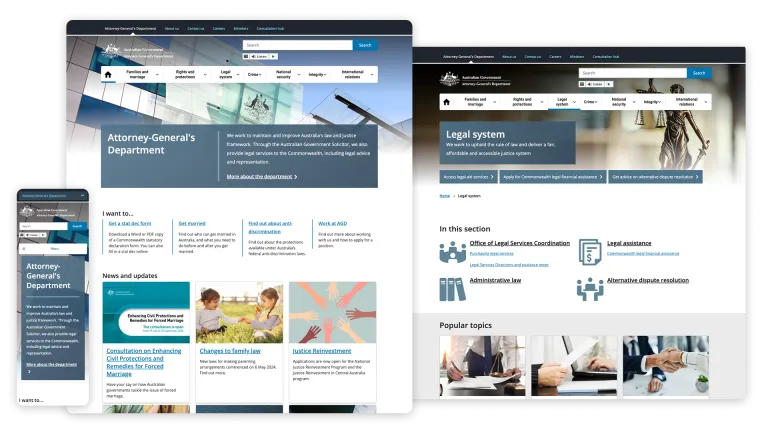
AGD website screenshots

The solution

Morpht re-architected the site around nine sections, each with its own landing page and publication library, and migrated it from SharePoint to GovCMS. We worked in close partnership with the Digital Applications section throughout.

AGD website on multiple devices

Human-centred design

We started with audience personas, their information needs, and the jobs they need to do. We then analysed the site structure and content against the Department's objectives and publishing needs.

Example of website wireframes

Guiding the user flow

Each of the nine sections now works like a 'site within a site'. A landing page lets users explore popular content, factsheets, and forms, or go deeper.

AGD user flow

Focused searches

We designed nine publication libraries, one per section, each with faceted search. Users search in the right place and filter results by topic and document type.

AGD focussed searches

Inclusive and responsive design

We designed to WCAG 2.1 AA, decluttered the interface, and used a consistent visual language from the design system. Each section has its own photography, and icons act as signposts. Plenty of white space helps mobile users scan content quickly.

AGD website displaying on a mobile screen

Content migration

We partnered with Systemik Solutions, specialists in public sector migrations, using PerformX Content Workbench. Its iterative mapping fitted our Agile sprints and kept content freezes to a minimum.

With AGD stakeholders, we ran discovery, analysis, definition, testing, and final migration. The mapping covered:

  • old page structures fitted into new layouts
  • duplicate files in different formats consolidated into one publication page with downloads
  • pages and publications assigned to sections, topics, and document types
  • thousands of unique URLs redirected to the new structure
AGD cont migration

Making web development Convivial

We built on Convivial for GovCMS, Morpht's GovCMS starter site. It adopts the Australian Government Design System and adds content components and layout modifiers, so editors can build pages quickly without developer help.

The build included, amongst other things:

  1. 19 content types and subtypes
  2. 8 page layouts
  3. More than 6,000 pages
  4. 9 document libraries with faceted search
  5. HTML navigable books
  6. Site sections with custom header photography
AGD homepage
testimonial icon

"Working with Morpht to develop the site on GovCMS has been a highly successful collaboration. Their expertise and willingness to explore problems and create effective solutions greatly benefited the end product. It also made the process of developing and migrating the site to the new platform a smoother and more effective one, even with the added complications of a dispersed workforce as a result of COVID-19 restrictions." 

Scott Wright, Digital Applications, Attorney-General's Department

Related case studies