

Therapeutic Goods Administration

More than 5.5 million people a month use the Therapeutic Goods Administration (TGA) website for safety updates and guidance on medicines and medical devices. Morpht rebuilt it on GovCMS after 15 years of accumulated debt, turning more than 95,000 register records into searchable pages and giving editors consistent tools to publish complex guidance.

95,000 records, one connected website

The TGA now has a structured, consistent website that helps health professionals, industry, and the public find trusted information quickly, and a foundation for the next stage of its digital transformation.

71

content types consolidated into 49, a 31% reduction

31

search interfaces with filters across safety updates, alerts, publications, and 17 data feeds

45000

content pages to review, update and migrate

95000 +

Australian Register of Therapeutic Goods (ARTG) records published as individual, searchable pages

5 + million

site visitors a month

About the TGA

Drupal 9 | Convivial GovCMS | Web development | Content migration

The TGA, part of the Department of Health, regulates the quality, supply, and advertising of medicines, medical devices, blood products, and most other therapeutic goods. With its industry portals, the website supports $1.5 billion in service transactions.

The TGA commissioned Health's design partner, Folk, to lead discovery, user research, and design. Folk engaged Morpht, a long-standing collaborator, to lead the technical investigation and redevelopment.

Our audit found fragmented information that eroded user trust and increased maintenance costs, including:

  • content types to retire or consolidate
  • data feeds that were not linked to give the full picture
  • taxonomies that were mostly redundant or did not filter content well
  • content pages to review, update, and migrate
Visit the site

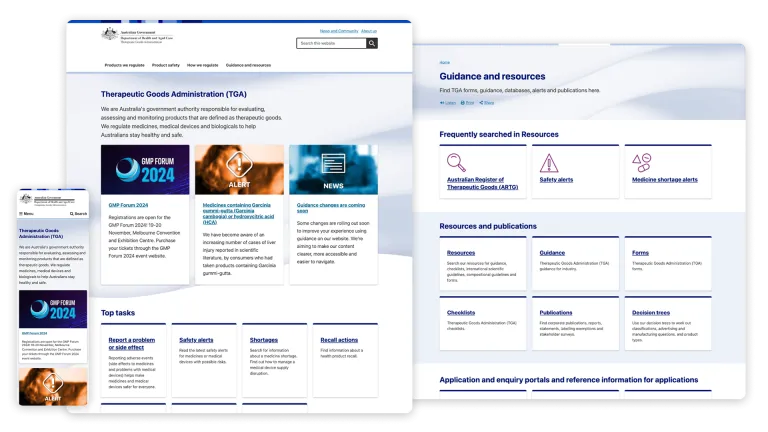
TGA website screenshots

The solution

The year-long project centred on three themes: structured content, search and findability, and consistent experiences.

TGA device mockup

Structured content

With the TGA User Experience and Web teams, we consolidated 71 content types into 49. The ARTG is the TGA's most accessed database, so we gave each of its 95,000+ records its own page, linked to related data feeds. This gives users a connected view of each product and strengthens the TGA's authority in search results.

Scripts create new pages, check for updates and duplicates, and unpublish deregistered goods automatically.

TGA content strategy

ARTG

The Australian Register of Therapeutic Goods (ARTG) is the TGA's most-used database, with more than 95,000 registered products. We gave every record its own page and linked it to related TGA data. Users can now see a product's full registration history in one place, and search engines can find each product more easily.

Scripts we built keep the records current. They automatically add new products, apply updates, remove duplicates, and unpublish deregistered goods. A dedicated ARTG search, available from key pages and the main site search, lets users filter results and explore related information.

TGA ARTG search

Search and findability

Alongside the main site search, users have 31 contextual search interfaces with filters (faceted search) for safety updates, product alerts, publications, and 17 data feeds, most linked to the ARTG.

TGA search

Consistent experiences

Consistent patterns make the site easier to use. An 'Alert type' classifier surfaces the latest product alerts and promotes those that need immediate action, and the same pattern runs across news, publications, and data feeds.

TGA search on smart phone

Data feeds

Data feeds across the site are now presented with the familiar faceted search interface and individual records laid out in a consistent fashion giving clear hierarchy to the presentation of data points.

TGA consistent experiences

Content magnets and topics

We introduced the content magnet, a component editors place on a page to display alerts, resources, and publications filtered by topic and audience. Topics became proper landing pages that surface news, alerts, and updates, and editors can create new ones without developer help.

TGA powerful magnets

Topics

While these weren't new concepts for the TGA, they were, however, being used inconsistently and without much effect. We uplifted the Topic from the guise of ‘category’, created a node template for it and equipped it with pre-programmed views to surface ‘flow’ content such as news, alerts, updates etc.  We also used the topic as a classifier for most other content types to help expose content in faceted searches and of course the magnets. Editors can now create new topic pages without relying on developer skills. 

TGA topics

Editors tools

At Morpht, we have a long standing commitment to enabling and equipping site managers, editors, authors, and content creators with web management tools to reduce their reliance on developers to create page layouts. The TGA are now able to create new pages following established patterns and layouts, while having the flexibility to craft page layouts by using the extensive toolset we’ve built in Convivial for GovCMS paired with the Awesome Starter Kit developed by the Australian Department of Health Online Services area.

TGA editor tools

Platform and migration

The legacy site ran on privately hosted Drupal 7. We moved it to GovCMS SaaS, combining the Department of Health's Awesome Starter Kit (ASK) with tools from Convivial for GovCMS on the Health Design System.

We wrote 65 scripts to migrate and transform content, tested an initial migration, and refined the scripts before the final run. We also fixed legacy redirects and created new ones for changed URLs.

TGA homepage on smart phone

Migration

The imperative to consolidate and rationalise meant that content needed to be transformed from 71 into 49 content types. To deliver on that, we worked on an extensive migration mapping process and created 65 scripts to migrate and transform content. We ran and tested an initial migration and iterated on the migration scripts before running the full and final migration, all with the support of and close collaboration with the TGA User Experience and Web teams.

The migration process also included numerous rounds of fixing legacy redirects and implementing new ones to address the changes in URL structures and content that was unpublished during the content audit.

TGA migration of thousands of pieces on content

Testimonial

icon

testimonial icon

Testimonial from TGA

“I recently worked with Morpht on a complex web development project and was blown away by their professionalism and expertise. They were able to transition our old, legacy technology and content across to a modern, structured website that exceeded my expectations. Their attention to detail, commitment to quality, and collaborative approach is rare to find in the digital market. I would highly recommend Morpht to anyone looking for web development and support services.”

Clair Hammami | Director, Web Experience Section, Therapeutic Goods Administration.
 

Related case studies