

Respect@Work

Respect@Work helps Australian workers and employers prevent and respond to workplace sexual harassment, but each group needs different guidance. Morpht built the website for the Australian Human Rights Commission (AHRC) with lightweight personalisation that shows visitors the content relevant to them, without collecting personal information.

The right guidance, no personal data needed

Visitors see guidance tailored to whether they are an employer or an employee, using only data stored in their own browser, in line with the Privacy Act 1988.

  • Two audience segments, individuals (employees) and organisations (employers), each shown relevant content
  • Personalisation that uses only browser-stored behaviour data, with no personal information collected
  • Interactive decision trees that guide users through workplace scenarios
  • Staff tools to create targeted content for each audience without developer help

About Respect@Work

Convivial | Discovery | UX/UI Design | Content modelling | Segmentation | Personalisation

The site responds to Recommendation 48 of the Respect@Work report and is the public voice of the Workplace Sexual Harassment Council. The project needed to:

  • understand the site's audience groups and use personalisation to lift engagement
  • build a robust, scalable, user-focused platform
  • give staff tools to create targeted content
  • meet accessibility requirements and coding best practice
Visit the site

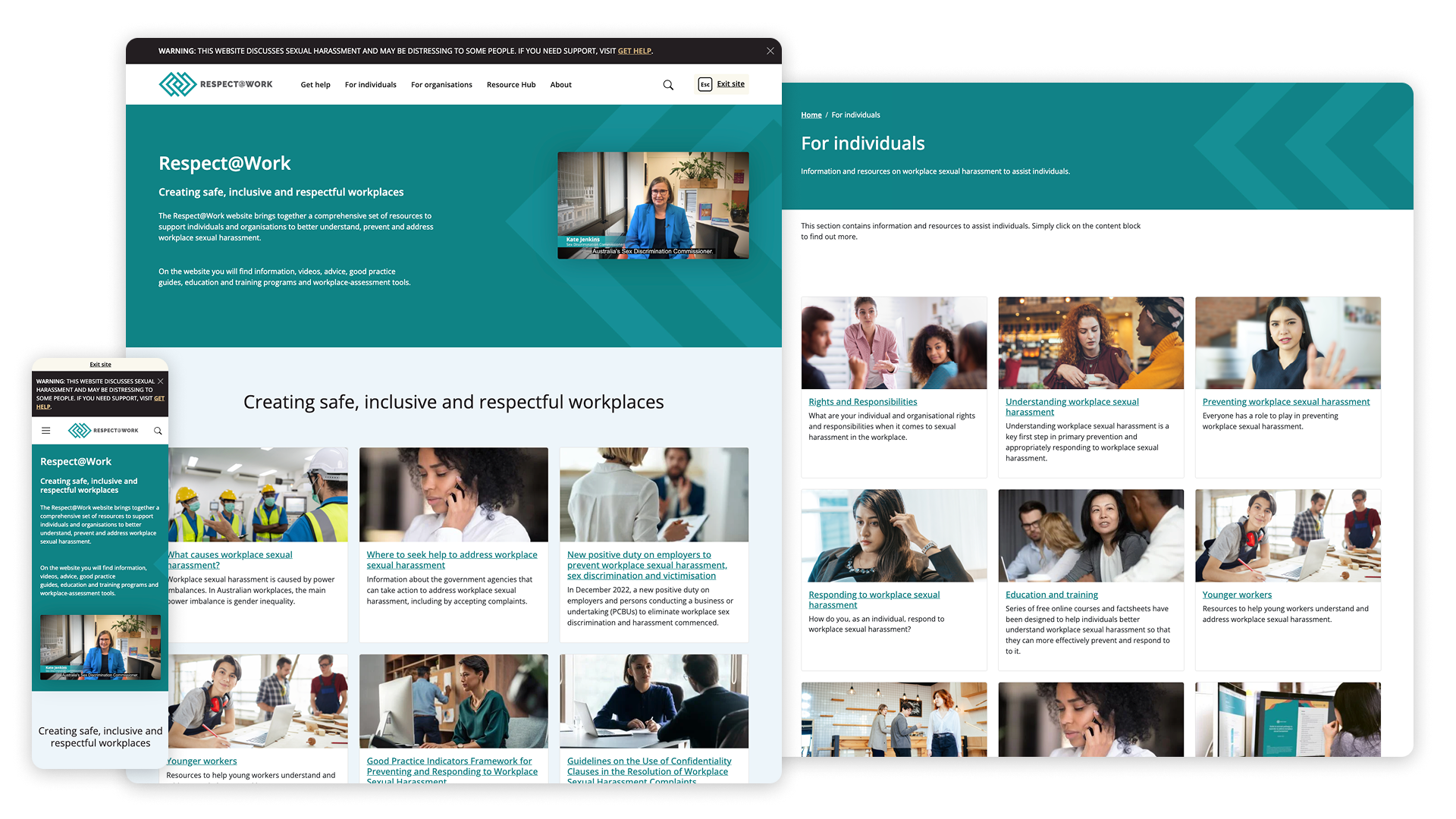
Respect@Work websites screenshots

The solution

Morpht followed the DTA's Digital Design Service Standards in defining, designing and developing the website. This included a Design Thinking Approach following the Double Diamond methodology and delivering the project in an Agile manner.

An essential part of the Morpht solution included a light-weight implementation of Personalisation which respects the Privacy Act 1988. The solution only uses stored behavioural data about the site visitor in their browser's local storage and targets user with content relevant to their needs. For example, as you click around the website, the solution learns that you are either an Employer or an Employee and as a result delivers educational material that is suitable to your interest.

respect at work website on devices

Discovery

At the outset of the project, Morpht conducted comprehensive Discovery sessions with key stakeholders to delve into the project's objectives and content requirements. A significant challenge was presented as the content was still in the conceptual phase, necessitating a flexible approach to accommodate the evolving work of content experts. From the Discovery phase, we determined that the project's key deliverables would include: a self-assessment tool for employers to evaluate workplace safety; decision trees to guide users through personal experiences and complex work situations; a resource hub offering a wide range of tools and content; and a light-weight personalisation solution to provide users with the information that is specifically targeted for their needs.

respect at work discovery

Content modelling and content types

A robust content model is crucial for building a DXP (Digital Experience Platform). In terms of Personalisation, both passive information (e.g., visits, location, time) and user interactions (e.g., clicks, actions) play a role. The R@W project incorporates standard Drupal content types like pages and resources, as well as powerful additions like promotions, audiences, groups, industries, decision trees enabling effective CMS Personalisation.

respect at work content types

DXP solution

Essentially the development of a DXP solution commences with the unpacking of the UX requirements including the documentation of the content types that will support the content requirements. For Personalisation these may be Audience and Goals, for a Decision Tree these may be Decision tree, Step and Answer and for calculators and self-assessment tools it may be a webform.


respect at work DXP solution

Audience segmentation

From our Discovery sessions it was quite clear that we had two key Audience values - Individuals (Employees) and Organisations (Employers). This informed the content model and information architecture providing an opportunity at the top level of our navigation to introduce these pivotal Audience pages to inform the users intent on the website.

The Audience content type also offered the opportunity to surface content that aligns with each audience type. By doing this, we are able to develop a deeper association between 'similar' content, and once established we can then use this relationship to drive specific content to each Audience based on their focus/interest.

In the case of the R@W project we have kept this simple with a central focus on Audience and Group to provide effective user segmentation and to provide the backbone to our personalised experience.

respect at work customer segmentation

Personalised content

Both Audience and Group serve as valuable tools for classifying and organising information. When combined with the Promotion content type, these classifications provide us with the ability to  control content blocks on web pages based on user interactions.

So when a user 'Organisation Audience', we establish a specific 'intent' for that user. This intent then becomes instrumental in manipulating content blocks across the entire site to surface information for that audience.

This approach enables us to trigger one or two personalised content blocks or even create an entirely personalised content page, tailoring the user experience to their specific needs and preferences.

Harnessing the power of such personalised content we deliver a superior user experience that improves engagement, conversion rates, and overall satisfaction.

respect at work personalisation

Under the hood

Morpht has developed an innovative solution called the 'Personified' module, designed to revolutionise content generation based on user variables stored locally in the web browser. This cutting-edge module seamlessly combines these variables with JavaScript-based templates to deliver personalised results, tailored specifically to individual users.

The 'Personified' module operates in two distinct ways, providing versatility and flexibility in content customisation:

  1. Personalised Messages: By directly leveraging the user variables, the module generates personalised messages on the fly. This dynamic approach ensures that users receive content that resonates with their unique preferences and characteristics.

  2. JSON Endpoint Query: The module also has the ability to query a JSON endpoint, fetching content that is then transformed based on the user variables. This dynamic content retrieval and transformation process ensures that users are presented with up-to-date and relevant information tailored to their needs.

This remarkable functionality is built upon the foundation of the JSON Template module, a valuable contribution by Morpht to the Drupal community. 

respect at work drupal module

Decision trees

Interactive Decision Trees offer a way to guide users through a Q&A and step-by-step process, arriving at an outcome which can provide information and resources that they need.

For R@W the Decision Tree has been used to aide a user in working through a challenging and confronting scenario at work such as  ‘How to respond as a witness to sexual harassment’.

In this Decision Tree a user is presented with a scenario with a series of choices, very much like a multiple choice scenario. At each step through the process, the user selects what path they think they should take - in the case of the R@W project, this Decision tree has 3 scenes, with a final conclusion offering personalised feedback and links to resources.

respect at work decision trees

Google Tag Manager

Google Tag Manager (GTM) offers a very flexible backend interface for adding custom scripts or tags. It can therefore be used to orchestrate various duties including page tracking and event logging on a site. With a bit of know how it can be customised to collate rich analytics data which matches the ontology for your site, adding a lot more value and insights into how people are engaging with the Drupal DXP.

respect at work gtm
testimonial icon

A huge thanks to you and the team for your terrific work on Respect@Work – I often say the best decision we made on the journey was choosing Morpht as the developer for the project. You should be very proud of your work here and the impact it is, and will in the future, have on Australian workplaces.


Peter Downs | Senior Policy Officer, Respect@Work


Related case studies