

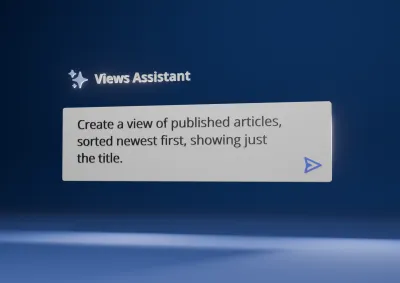
Stop writing prompts that sound like YAML. The Drupal Views AI agent now speaks plain English, and it brought a chatbot.
AI that works within your governance
The main risks of AI in government content are accuracy, bias, and auditability. We reduce them by using AI as an assistant, not a publisher: it drafts, suggests, and searches, and people review before anything goes live.
Drupal's structured content and role-based permissions give AI a well-defined, governed body of content to work from.
What you get:
- Faster content work. AI-drafted summaries, teasers, and tags that editors review and approve.
- Search that understands what people mean. Semantic search matches the meaning of a question, not only its keywords.
- Answers with guardrails. Chatbots that draw on your own content, with your data kept under your control.
Our approach to AI

Start with your content
AI is only as trustworthy as the content behind it. We begin with your content model and governance rules, so AI works from well-structured, approved material.

Help editors, and keep them in charge
Our Augmentor module and the Drupal AI module let editors generate teasers, summaries, and tags inside Drupal. Everything goes through the normal editorial workflow before it's published.

Make search understand meaning
Semantic search uses a vector database to match the concept behind a question with concepts in your content. On GovFlix, our proof of concept, results better matched what people were looking for.

Answer questions with a chatbot you control
Our chatbots draw answers from several content sources, and you control how data is stored and shared. We set up guardrails that can block or rewrite prompts and responses, including to protect personal information.

Plan for government platforms
Convivial for GovCMS AI Edition is in development for GovCMS PaaS, so agencies can use Drupal AI features on a foundation built for government.
Examples of our AI work
The “AI Edition” can be installed in GovCMS PaaS to take advantage of Drupal AI functionality and the site, on top of a wide range of AI services.
A feature we sponsored that lets site builders create and update Views using plain language.
Our module adds AI-generated summaries, teasers, and taxonomy tagging to the editing experience.
Frequently asked questions
The Drupal AI Initiative, launched in June 2025, is building AI capabilities into the platform. The 2026 roadmap covers AI-assisted page generation, context management so AI follows brand voice and governance rules, background agents for content tasks, AI search, design system integration, and audit trails. We're a Gold AI Maker in the initiative.
We use our Augmentor module to help editors draft, improve, and tag content. That reduces manual effort and helps teams keep quality consistent at scale. We also use AI to improve search, content recommendations, and automated tagging.
Yes, with appropriate governance. The Australian Government encourages agencies to explore AI while emphasising responsible and transparent use. In Drupal, AI works within defined roles and permissions, and editors can review changes before publication. We design our integrations with government compliance in mind.
Yes. We've worked extensively on search accuracy and relevance for government sites. Beyond keyword search on Apache Solr, we've implemented autocomplete, content boosting by type and recency, and faceted search by topic, audience, and date. We've also researched context-aware search, which adjusts results to the user's situation.
The main risks are accuracy, bias, and auditability. Poorly governed AI can produce inaccurate content or an inconsistent tone, which damages public trust. We implement AI as a drafting and assistance tool, not an autonomous publisher, and all AI-generated content goes through human review before publication.
Convivial Profiler, Morpht’s personalisation engine, tailors content on Drupal sites without building server-side profiles of visitors. It runs in the visitor’s browser, uses no tracking cookies or personal identifiers, and keeps the profile on the visitor’s device. It is built into Convivial and Convivial for GovCMS, and can be added to other Drupal sites.
Traditional personalisation sends visitor behaviour to a server or third-party platform and stores it there. Convivial Profiler does the work in the visitor’s browser instead, so no visitor data is sent to a server. Organisations can tailor content without creating a new store of personal information to secure, govern, and report on.
Convivial Profiler learns which topics a visitor is interested in, what they are trying to do, and where they are in a campaign or journey. Editors can then show relevant content, promotions, and top tasks for each audience. For the Australian Human Rights Commission’s Respect@Work site, privacy-safe personalisation shows employers and workers the information that applies to them.
Yes. Morpht’s GovFlix proof of concept shows GovCMS SaaS delivering personalised recommendations, semantic search, and an AI chatbot without collecting personal data. Where an organisation wants machine-learning recommendations, Morpht integrates Recombee, which links visits with a pseudonymous identifier and does not receive names or email addresses.
It helps. Collecting less personal information makes it easier to meet the Australian Privacy Principles and data minimisation requirements. Consent and opt-out controls can be configured to match your organisation’s policy, and Morpht documents data flows so your privacy team can assess them.
Yes. Convivial Profiler and Recombee recommendations work on both GovCMS SaaS and PaaS. Agencies can engage Morpht for personalisation through the GovCMS Drupal Services Panel, where Morpht is a supplier in the digital experience platform (DXP) category.
Yes. Convivial, Morpht’s Drupal starter site, includes the same personalisation tools for higher education, health, not-for-profit, and enterprise organisations. Personalisation is built in from the start, so it does not need a separate platform or a large data project before you can begin.
Case studies

Case study
GovFlix is Morpht's proof that GovCMS SaaS can deliver personalised recommendations, semantic search and an AI chatbot, with no personal data collected.
Latest insights
Article
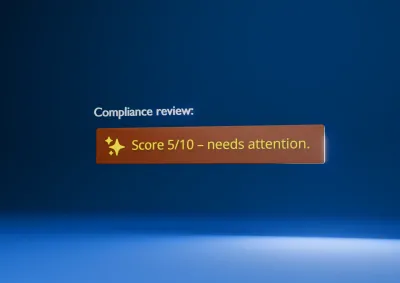
Your content writing guidelines can now grade your content. An AI agent scores every article from 1 to 10 against site governance and lists the exact fixes.

Article
Your fields can now think. Route any Drupal field automator through a tool-using AI Agent and let RAG pick the answer.
Article
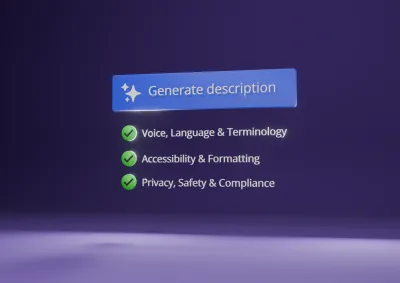
One rulebook for your AI: make every generated intro, summary and alt text follow the exact same governance as your chatbot.